

Quick Summary
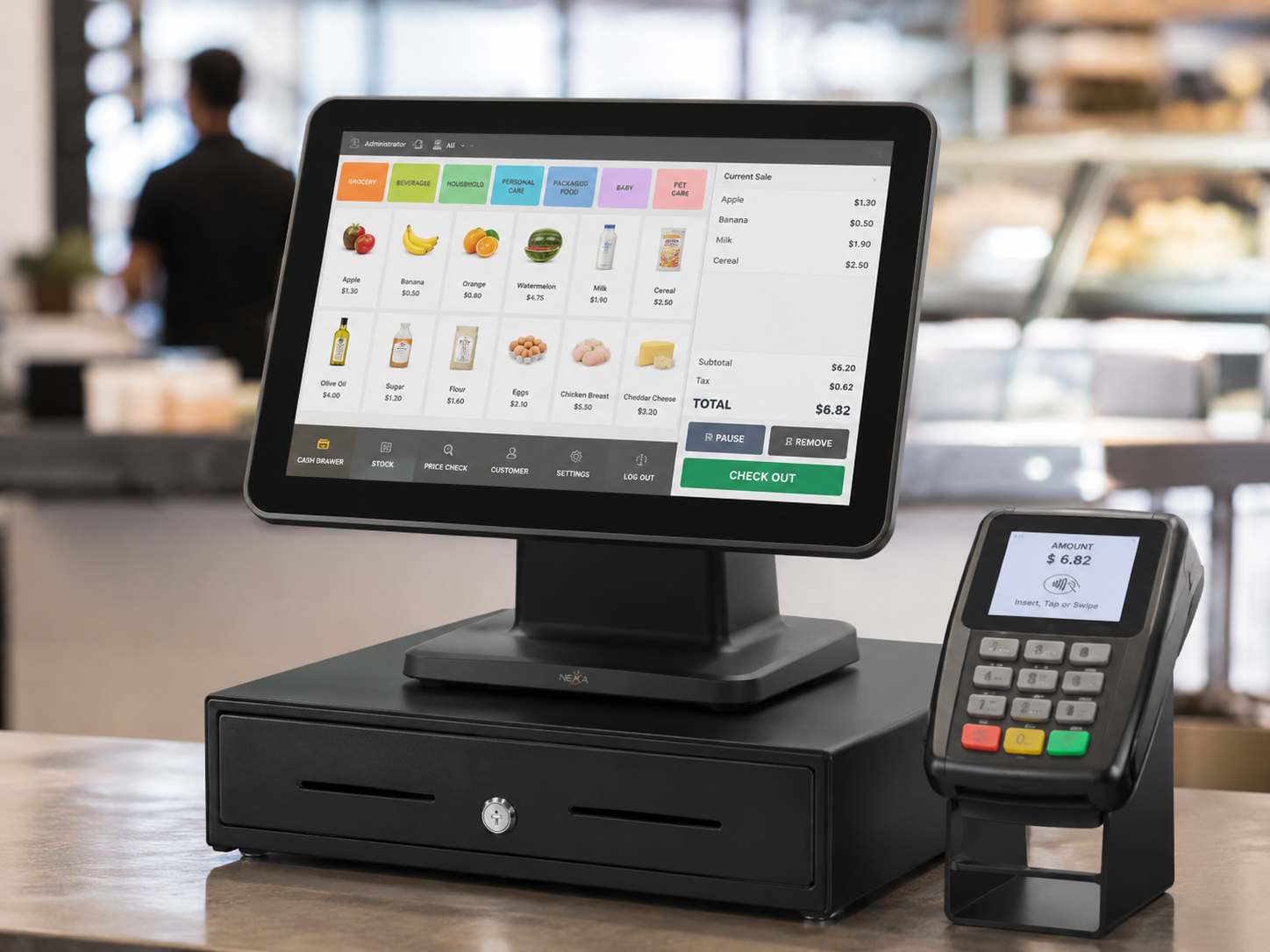
Square is a simple, app-based POS that works nicely for mobile vendors and small storefronts. It easily handles light, in-person selling. Stores carrying real compliance weight, like grocery, convenience, and liquor, tend to push its limits.
Here’s the quick pros-and-cons view.
Pros | Cons |
|---|---|
Fast, free setup | No native EBT, SNAP, or WIC |
Transparent flat-rate pricing | Locked to Square processing |
Polished, easy interface | Flat-rate fees climb at high volume |
Strong mobile and small-shop fit | Account holds and fund freezes |
Connected all-in-one ecosystem | Thin native tools for specialty retail |
Overview of Square POS
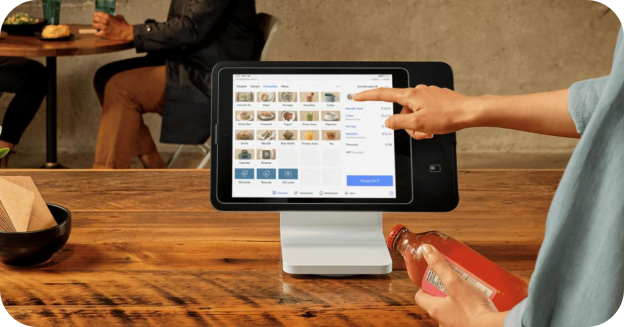
Square is a cloud-based POS paired with its own payments service.
Software, hardware, and card processing arrive as one package. Sign up, choose a plan, download the app, and every sale routes through Square. A library of add-ons fills in whatever the base product leaves out.
The platform spans business types, with a single app that adapts for retail, restaurants, and appointment-based work. The 2025 rebuild folded Square’s old per-industry subscriptions into a handful of tiers. The more you pay, the more you have access to.
Square goes to market directly, not through a reseller channel, so the rate you are quoted is the rate everyone gets. The trade-off is a sealed system. Square Payments is the only processor on offer, meaning you can’t bring your own merchant account or shop for a cheaper rate.
For plenty of merchants, the quick onboarding and tidy interface are reason enough to sign on. For categories that live on regulation, like grocery POS, the math starts to shift.
Key Features
Square handles the essentials that every small operator expects. The highlights are below.
Hardware Lineup
The device range covers most counter setups:
- Square Reader: free magstripe reader, plus a contactless and chip reader
- Square Stand: turns an iPad into a countertop register
- Square Terminal: handheld all-in-one with a built-in printer
- Square Handheld: portable device for mobile ordering and scanning
- Square Register: full two-screen checkout station
The hardware is well-made, and most cashiers can pick it up in a single shift.
Payments and Checkout
- Cards go through by swipe, chip, tap, or mobile wallet
- The checkout flow is fast and dependable, which helps when lines back up
- EBT, SNAP, and WIC don’t run through Square on their own, a gap we come back to
For our view on POS payments in independent retail, start here.
Inventory and Reporting
- Stock counts update automatically, with a nudge when items run low
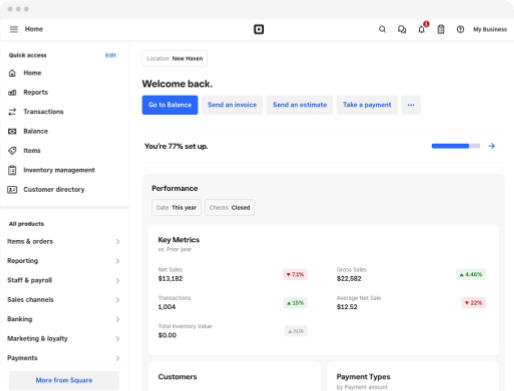
- Sales figures stream to a dashboard you can open from any device
A short product list is no trouble. Once the catalog runs deep, you’ll start leaning on add-ons to keep pace.
Employee and Customer Tools
- Staff logins, role permissions, and shift records come standard
- Add Square Payroll to run pay cycles from the same place
- Loyalty, gift cards, and marketing sit in the add-on layer rather than the base app
App Marketplace
- Loyalty, online selling, payroll, and richer inventory are usually a download away, with no new hardware required
That extensibility is where Square shines. The catch is recurring cost, since most add-ons bill every month.
Pricing
Three things decide Square’s price: the plan, the hardware, and the processing.
Because Square sells direct, the numbers don’t swing from one buyer to the next, though they do move over time. Read the figures below as a 2026 estimate, not a firm quote.
Software Plans
Cost climbs by tier:
- Free plan: $0 per month
- Plus plan: $49 per month per location
- Premium plan: $149 per month per location
- Pro plan: custom pricing for high-volume sellers
Move up the tiers and your in-person rate drops while the toolset widens.
Hardware Costs
Hardware sits outside the subscription as a one-time spend.
- Square magstripe reader: first free, then about $10
- Square contactless and chip reader: $59
- Square Stand: $149
- Square Terminal: $299
- Square Handheld: $399
- Square Register: around $799, with full kits past $1,000
Square allows you to pay outright or spread payments over installments.
Processing Fees
This is the line that drives your monthly total.
Square charges flat rates. Card-present sales land between 2.4%–2.6% plus $0.15, set by your plan. Online sits at 2.9%–3.3% plus $0.30, and hand-keyed entries at 3.5% plus $0.15.
At low volume, a single flat rate is refreshingly simple. Push the volume up, and that same rate starts to sting.
Watch the Hidden Costs
A handful of charges tend to surprise teams as they scale.
- Most marketplace apps carry their own monthly charge
- The plan fee repeats for every location you run
- Pulling funds early costs 1.95% per instant transfer
- Afterpay financing takes 6% plus $0.30 on each sale
The sticker price and the final invoice rarely match. Model it against your real volume before you commit.
A Real-World Cost Picture
Picture a single-register shop running a Square Register on the Plus plan.
You’re out roughly $799 on hardware up front. The plan runs $49 a month per site, and 2.4%–2.6% comes off every in-person ticket. Layer on a loyalty or inventory add-on at $20–$100+ a month, and the monthly figure keeps building. For grocery or liquor turnover, processing alone can outweigh everything else combined.
Pros
A few things Square clearly gets right.
- Fast, free setup: you can be taking cards within minutes, no contract attached
- Transparent pricing: the posted rate is the rate, with no processor markup hidden underneath
- Easy on staff: the interface is clean enough to train in minutes
- One connected stack: payments, online orders, and reports under a single roof
- Anywhere reporting: live numbers from any device
- Made for small and mobile: a natural fit for markets, pop-ups, and one-location shops
Keep the operation simple, and Square gives you a clean, capable till.
Cons
The fit narrows as your needs get specific. Here’s what tends to wear on owners.
- Sealed processing: Square Payments is mandatory, so you lose any rate leverage
- No built-in benefits cards: EBT, SNAP, and WIC only work through an awkward outside add-on
- Flat rates that scale against you: the percentage bites harder as volume rises
- Sudden holds: Square can freeze a balance or close an account with little notice
- Add-ons that pile up: loyalty, online ordering, and payroll each bill separately
- Shallow for specialty: lacks the inventory and compliance depth that regulated retail requires
For a coffee bar, none of this hurts. For specialty or high-turnover stores, it shows up daily.
Who Should Choose Square
Square earns its reputation with the right kind of store. It’s worth a serious look if you see yourself here.
- You run a pop-up, market stall, or mobile business
- You operate a boutique, cafe, or simple general retail store
- You run a service business that needs clean checkout and booking apps
- You want a plug-and-play setup and polished hardware
- Your inventory and compliance needs are light
- You process modest card volume, so flat-rate fees stay reasonable
Tick most of those boxes, and Square is a solid, low-risk pick.
Who Shouldn’t Choose Square
Square was built to serve almost any business, which means it serves none of them deeply. Pause before signing up if this describes your store.
- You sell groceries and depend on WIC, EBT, and slim category margins
- You run a convenience store that needs tobacco scan data and quick age checks
- You operate a liquor store that breaks cases and chases supplier rebates
- You run several locations and want room to negotiate or change processors
- Your card volume is high, the point where a flat percentage quietly drains margin
- You’d rather have a local partner than a help desk
For stores like these, the small frustrations compound. When the fix requires more than one paid app, Square stops being the simple system you signed up for.
What to Choose Instead
If Square doesn’t fit your store, here’s what a better-suited system looks like.
Native Compliance, Not Add-Ons
For grocers and c-store owners, benefits and compliance are daily realities, not edge cases. WIC, EBT, and tobacco scan data should live inside the system, not hang off it.
A bolt-on covers the gap until the day it breaks. Our convenience store POS builds compliance in as a core function rather than charging for it as an extra. Age checks and quick scan-data reporting should run from the same screen your cashier already uses.
Inventory Built for Your Workflow
A liquor store splits cases into single bottles. A grocer buys against deal cycles and protects margin inside short windows. Neither maps onto a generic stock counter.
The system should know case cost, bottle cost, distributor IDs, and vendor programs without an extra app. That’s the baseline we expect from grocery inventory tools. Plenty of independent grocers skip perpetual inventory entirely and run on deal-buying margin instead, so the software has to match how they actually buy, not force a method on them.
The same goes for liquor. A missed rebate window is a margin you never get back, which is why rebate and supplier automation sit directly inside our liquor store POS.
Smart Replenishment for C-Stores
A convenience store runs on fast-movers. Every empty hook or shelf is a missed impulse buy.
A system built for that format tells you what’s moving and when to reorder, so your strongest shelves stay stocked without any guesswork.
Built for Generational Transitions
A lot of independent grocery businesses are passing to the next generation right now. The new owner tends to want current technology, not the aging setup they inherited.
A flexible, well-backed POS smooths that handover. It helps support a store that is built to grow, not just keep the lights on.
Processing You Can Negotiate
A closed platform takes away your bargaining power. An open one lets you keep shopping rates as your volume grows.
That matters most when you run multiple locations, where a fraction of a percent compounds across every register.
Add-Ons That Fit Your Store
Upgrading should feel like a choice, not a chore. Take a look at our self-checkout, loyalty programs, and electronic shelf labels for a sense of what we mean.
Each should slot in without fighting your POS or springing a new monthly fee on you.
Local Service That Shows Up
A jammed lane on a Saturday afternoon doesn’t wait for a ticket queue. Our regional partners know your store by name and are always ready to step in and get you running again.
That’s where a vendor and an advisor part ways. One hands you a box. The other stays with you while you build the business.
The BMC Perspective
Time for the honest part. BMC has worked with independent retailers since 1958.
We build for the way grocery, c-store, liquor, and thrift operations actually run. We’ll say our bias plainly: compliance, deep inventory, and rebate tools belong in the core platform, not rented through a marketplace, and a local relationship beats a phone queue every time.
Square is a capable tool for most general businesses. Behind a market stall or a small boutique counter, it holds up fine. In a margin-sensitive, compliance-heavy specialty store, the gaps start to cost you.
Choose the system shaped around how your store runs, not the one you have to reshape. Request a demo today.