

Quick Summary
Clover POS pricing is comprised of four layers: hardware, software, processing, and add-on apps. While software is the most commonly quoted expense, for high-volume small-basket businesses like c-stores, processing accounts for roughly 90% of the monthly bill.
How Much Does Clover Really Cost You?
Most Clover POS pricing guides quote you a monthly software plan and stop there. In reality, that number is the smallest line on your bill. The real money sits in processing fees. For buisnesses with small basket sizes or high card volume, those fees, not the software price, ultimately decides you bill.
This page breaks down all four cost layers, then adds them up for a real store. If you want the feature side rather than the numbers, start with our Clover POS review.
Clover Pricing Plans
Clover bills you in four places. Here is the overview before we dive deeper:
| Cost layer | Typical range |
|---|---|
| Software plan | $0 to $89.95 per month, per location |
| Hardware | $199 to $1,899 per device, upfront |
| Card processing | 2.3% to 2.6% + $0.10 in person, 3.5% + $0.10 keyed |
| Marketplace apps | $5 to $99+ per month, each |
Two figures do the heavy lifting: the percentage rate and the ten cents. Everything else is rounding error at retail volume.
Why Do Clover Price Quotes Never Match?
Search for Clover pricing, and you will find six different answers. There is a reason for that, and its not malicious.
Clover is sold two ways. You can buy hardware upfront and pay a software fee, or you can bundle hardware and software into one monthly payment over 36 months. A “$180 per month” quote is usually the bundle. An “$84.95 per month” quote is software only. Both are accurate, but they describe different deals.
Rates also move by reseller. Clover is a Fiserv product distributed through banks, independent sales organizations, and warehouse clubs. Each one sets its own processing rate and contract terms. Two stores can run identical terminals on very different numbers.
Ask any seller for a line-item quote covering software, hardware, rate, term length, and cancellation terms. Anything less is not comparable.
Clover Software Plans
Plans are organized by business type. These plans represent the software-only fees when you buy hardware upfront.
| Plan | Monthly | Card-present rate |
|---|---|---|
| Payments | $0 | 2.6% + $0.10 |
| Essentials | $14.95 | 2.6% + $0.10 |
| Virtual Terminal | $14.95 | 3.5% + $0.10 |
| Counter Service Restaurant | $59.95 | 2.3% + $0.10 |
| Retail Growth | $84.95 | 2.3% + $0.10 |
| Table Service Restaurant | $89.95 | 2.3% + $0.10 |
Note what happens across that table. Moving from Essentials to Retail Growth costs $70 more a month and drops your rate by 0.30%. On $145,000 of monthly card volume, that trade saves about $437 a month. For most businesses, the expensive plan is the cheapest one.
Retail Growth is the tier most retailers land on. It adds item variants, returns and exchanges, scale and scanner support, and a basic loyalty program. Additional terminals at the same address run roughly $14.95 a month each.
Clover Hardware Options

Hardware is a separate upfront purchase. Clover software only runs on Clover devices, so nothing carries over from your current system.
| Device | Price | Notes |
|---|---|---|
| Clover Go | $199 | Card reader for a phone or tablet |
| Clover Compact | $349 | Handheld with printer |
| Clover Flex Pocket | $699 | Handheld, no printer |
| Clover Flex | $749 | Handheld with printer and scanner |
| Clover Mini | $849 | Countertop, cash drawer sold separately |
| Clover Station Solo | $1,799 | Full station with drawer and printer |
| Clover Station Duo | $1,899 | Adds a customer-facing screen |
Scales, scanners, and PIN pads are extra. A two-lane counter with peripherals lands closer to $4,000 than $2,000.
Should You Buy Or Finance?
Financing helps with cash flow but costs more overall. Here is the math on a Station Duo:
- Buy outright: $1,899 hardware plus $84.95 monthly software for 36 months comes to $4,957
- Bundled monthly: about $180 a month for 36 months comes to $6,480
That is roughly $1,500 extra for the same equipment. Financing also ties you to a 36 or 48-month term, and early cancellation means paying the remaining balance.
Buying upfront also gives you something to negotiate with. Sellers who make their margin on leases have less room to move on your rate.
Clover’s Processing Fees
This is where the real spend happens.
Card-present transactions run 2.3% to 2.6% plus $0.10. Keyed, phone, and online orders run 3.5% plus $0.10 on every plan.
Here is the part that catches convenience store operators in particular. The percentage scales with your basket. The dime does not. On small baskets, that fixed fee turns into a large percentage.
| Average basket | $0.10 as a share of the sale | Effective rate at 2.3% + $0.10 |
|---|---|---|
| $3 | 3.33% | 5.63% |
| $5 | 2.00% | 4.30% |
| $9 | 1.11% | 3.41% |
| $15 | 0.67% | 2.97% |
| $40 | 0.25% | 2.55% |
A typical candy bar sale on a card costs you more than five percent in fees. Nobody quotes you 5.63%, but that is the reality.
This is why flat-rate pricing suits a furniture store and punishes a c-store. High transaction counts and low basket sizes make the worst possible combination for a per-transaction fee. Our view on how POS payments should be structured for independent retail starts from this exact problem.
Clover Apps
The App Market is how Clover handles anything past the basics. Loyalty, scheduling, advanced inventory, accounting sync, and online ordering are each a separate subscription.
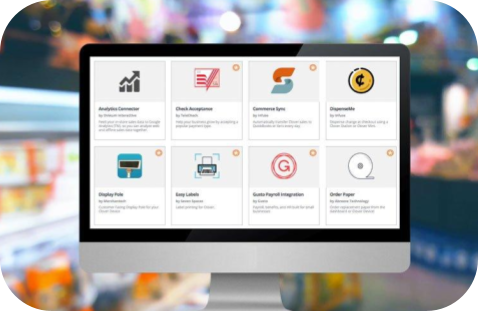
Most apps land between $5 and $30 a month. Advanced inventory tools run considerably higher, into the $49 to $229 range depending on the app and tier. Install four or five during setup, and you have added $80 to $120 a month before selling anything.
What Clover Costs a Convenience Store
Here is a full first-year picture for a standard single-location c-store. Assumptions are stated so you can swap in your own numbers.
The store:
- $2.5M in annual sales, $208,333 a month
- Seventy percent of that on cards, so $145,833 in monthly card volume
- A $9 average basket, which works out to about 16,200 card transactions a month
- Two Station Duos on Retail Growth
- Three marketplace apps averaging $25
| Monthly line item | Cost |
|---|---|
| Retail Growth software | $84.95 |
| Second terminal | $14.95 |
| Three marketplace apps | $75.00 |
| Processing, 2.3% of card volume | $3,354.17 |
| Processing, $0.10 x 16,200 transactions | $1,620.37 |
| Monthly total | $5,149.44 |
| Year one | Cost |
|---|---|
| Hardware, two Station Duos | $3,798.00 |
| Software and apps, 12 months | $2,098.80 |
| Processing, 12 months | $59,694.48 |
| Year one total | $65,591.28 |
Processing is 91% of that total. Software and apps together are 3%.
The effective rate works out to 3.41%. At this volume, every 0.10% you negotiate off the rate is worth about $1,750 a year. Every dollar you argue about on the software plan is worth twelve.
That ratio is the whole point. Operators spend weeks comparing plan features only to sign whatever rate is hiding on page four.
The Costs That Do Not Appear in Any Quote
A few charges show up after the contract is signed.
- Early termination: cancelling a 36 or 48-month term means paying the remaining balance
- Processor lock-in: Clover terminals are provisioned to Fiserv and cannot be reprogrammed to another processor, so a better rate later means replacing the hardware
- Reserve holds: newer accounts can have a percentage of sales held for 90 to 180 days
- Compliance workarounds: these are the ones that hurt in grocery and c-store
Clover supports EBT once your account has the entitlement activated, but WIC is not supported natively. If your POS is not eWIC certified, you need to run a separate terminal alongside it.
In a state like Wisconsin, a WIC processor costs $82 a month per device plus a $100 annual security fee. Terms differ by state, so confirm with your own agency.
That is a second device on your counter, a second workflow for cashiers, and a recurring charge that never appears in a Clover quote. For a store where benefits tender is a real share of sales, it changes the math.
Who Clover Makes Sense For
The pricing works when your basket is large, and your compliance needs are light, for example:
- Cafes, quick-service restaurants, and bars
- Boutiques, gift shops, and general retail with average tickets above $20
- Service businesses billing a few dozen transactions a day
- Single-location operators who would rather have one simple setup than room to haggle
- Anyone who wants hardware, software, payments, and support on one invoice
If that describes your store, Clover offers reasonable value and a great user experience.
Who Should Explore Alternatives
The math turns against you in a few specific situations:
- Low ticket, high count: c-stores and quick-stop retail, where the per-transaction fee dominates
- Benefits tender: stores where WIC and EBT are a meaningful share of sales
- Deal-cycle buying: grocers managing margin through buying windows rather than perpetual counts, which needs deeper grocery inventory tooling than apps provide
- Case-level stock: liquor store operators splitting cases and tracking supplier rebate windows
- Growth plans: operators adding sites, where rate flexibility across multiple locations compounds
For these stores, the honest comparison is not Clover’s plan price against someone else’s plan price. It is total first-year cost including your effective rate, your compliance workarounds, and what happens when you want to renegotiate in year three.
The BMC View
We have been selling point-of-sale systems to independent retailers since 1958. Our position is that processing terms should be negotiable and compliance should be built in rather than bolted on.

If you are pricing Clover for a convenience store, do one thing before you sign. Take your real transaction count and your real average basket, run them through the table above, and compare the effective rate to whatever appears on the front of the quote.
If the two numbers are far apart, we should talk. Request a demo, and we will price it out honestly, including the parts where Clover wins.
FAQ
How much is Clover per month for a small store?
Budget $85 to $100 a month for software on a two-terminal retail setup, plus processing. Processing is the larger number. At $50,000 in monthly card volume and a $10 basket, expect around $1,650 a month in fees.
Is there a cheaper Clover plan that still does inventory?
Essentials at $14.95 covers basic stock tracking. Item variants, returns and exchanges, and scale integration require Retail Growth at $84.95. The higher plan also carries the lower processing rate, so it is often cheaper overall.
Can you negotiate Clover’s processing rate?
With resellers, often yes, particularly above $10,000 a month in volume. Ask specifically about interchange-plus rather than flat-rate. Buying hardware upfront strengthens your position.
Does the Clover plan you pick change your rate?
Yes. Payments and Essentials carry 2.6% plus $0.10. Retail Growth and the restaurant plans carry 2.3% plus $0.10. Keyed and online transactions are 3.5% plus $0.10 on every plan.
What happens if you cancel early?
You owe the balance remaining on the term, typically 36 or 48 months. Hardware leases are generally non-cancellable, which is a strong argument for buying outright.